|
Common questions and answers are listed below. You can check out the Non-Metallic
Mining Ordinance and other files and forms on the menu to the right.
Non-Metallic Mining Reclamation Frequently Asked Questions (FAQ)
What is nonmetallic mining?
Nonmetallic mining is the extraction of stone, sand, rock or similar material from
natural deposits. The most common examples of nonmetallic mines are quarries and
pits. Materials extracted can range from aggregate for construction; sand, gravel
and crushed limestone or dolomite for road building; peat for gardening and horticulture;
dimension stone for use in buildings, landscaping, and monuments; and sand that
is exported for use by the oil industry.
Nonmetallic mining does not include extraction of metallic mineral deposits containing
metals such as copper, lead or zinc, nor does it involve recovery of oil, gas or
coal.
How big a role does nonmetallic mining play in the economy of the state?
Nonmetallic mining is a widespread activity in Wisconsin, and there is an estimated
2,500 to 3,000 nonmetallic mine sites producing a wide variety of nonmetallic mineral
products. The U.S. Geological Survey has estimated that for 2001 the total nonfuel
mineral production for Wisconsin was $368 million. Druing 2001, Over 166 million
tons of crushed stone, dimension stone, and sand and gravel were produced in Wisconsin.
The industry provides materials for road building, construction, landscaping, agriculture
and other markets throughout the state and the nation. Each person in the United
States uses an estimated 10 to 20 tons of nonmetallic mining products each year.
Why do we need a Statewide Nonmetallic Mining Reclamation Program?
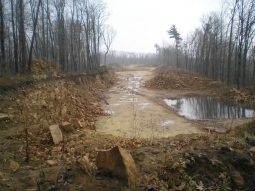
Unfortunately, there is a legacy of abandoned mines in Wisconsin. The absence of
regulations has played a role in this legacy. Too often, such sites are safety hazards
that create situations resulting in personal injury or even loss of life. Abandoned
mines can result in a loss of productive land use, diminished habitat and decreased
tax revenues. Abandoned mines can also have a negative impact on the property value
of adjacent landowners.
Threats to the environment and particularly to surface water can occur due to erosion
and sedimentation from both abandoned and active mine sites. These impacts can easily
be prevented by responsible practices encouraged by this rule. In a state proud
of its environment it makes no sense to accept the eyesores that come with abandoned
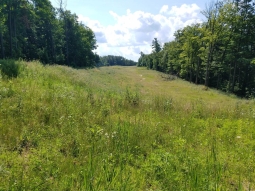
mine sites. This program will ensure that mine sites are returned to a productive
and beneficial land use once mining is completed.
Who would regulate the nonmetallic mining industry to ensure reclamation?
Each county is required by law to enact an ordinance and administer a reclamation
program to regulate the reclamation of nonmetallic mining sites. Cities, villages
and towns are given the option to regulate nonmetallic mining reclamation in their
jurisdiction. County or local programs will be established by the enactment of a
reclamation ordinance and maintained by the implementation and administration of
that ordinance.
What is the role of the Wisconsin Department of Natural Resources in this regulatory
process?
Subchapter I of Chapter 295, Wis. Stats, requires the Department to write rules
for Nonmetallic Mining Reclamation. These exist in Chapter NR 135, which became
effective December 1, 2000. Additional support materials have been developed including
model ordinances for use/adoption by counties and interested municipal governments.
In the longer term, DNR will provide technical assistance and perform audits to
ensure that county and local ordinances are being fully and uniformly enforced in
compliance with state law.
Would this rule affect the siting and permitting of proposed new mines?
No. This rule creates a reclamation program only. It is not a zoning rule and will
have no effect on local zoning decisions. The decision on locating a nonmetallic
mine will continue to be based on the physical presence of a deposit, the market
demands and the restrictions placed on these activities through the zoning process.
This rule deals only with final site reclamation and environmental protection and
has no affect on siting decisions.
Who will pay for the benefits that flow from a regulatory program aimed at ensuring
the reclamation of nonmetallic mining sites?
The law requires that county and local ordinances establish annual fees so the reclamation
program is fully funded by those fees. County or municipal government may recover
all reasonable costs that they incur in administering the program.
Will NR 135 help me with my concerns about noise, blasting, and traffic?
No. Chapter NR 135 deals only with the reclamation of mines. Concerns related to
siting and operations need to be addressed through zoning and other ordinances.
If a county has not enacted a zoning ordinance but does enact a nonmetallic mining
reclamation ordinance, does the county reclamation ordinance apply in those townships
within the county that have a local zoning in place?
Yes. The authority for a nonmetallic mining reclamation ordinance is independent
of zoning authority and the county nonmetallic mining reclamation ordinance would
apply unless the town elected, at its discretion, to enact its own non-metallic
mining reclamation ordinance thus assuming primacy.
I am concerned that operators will not know when all the county hearings on reclamation
ordinances (especially the proposed fee structures contained in the ordinance) will
occur and thus will not get an adequate opportunity to participate. How can I get
this information?
Interested parties should contact county and local government to get their name
on applicable mailing lists for hearing announcements put out by county or local
governments.
How can operators be assured that fees assessed by county and local government will
not be too high?
The statute provides county or local government with the ability to collect fees
for use in the administration of their program. These fees must equal, as closely
as possible, the actual costs of program administration. The fees that appear in
the rule in NR 135.39(4)(b)2 are specific to Department costs and are only applicable
when the Department is the regulatory authority required to administer the program.
Yet, the fees found in the rule also serve as a "reality check" on fees and the
rule indicates that there must be specific justification if county/local costs exceed
tables 2, 3, and 4. It is important to note that a regulatory authority may not
assess a fee in excess of what would be required to recoup its administrative costs.
One of the areas reviewed by the Department in mandatory audits of county or local
programs is the relationship between fees collected and actual administrative costs.
How can operators be assured that the county or local government regulatory authority
will have a fair and reasonable interpretation of the uniform reclamation standards?
Initially, all active operations that wish to continue to operate will receive an
automatic reclamation permit. Over the next 2-3 years more detailed reclamation
plans will need to be submitted for approval. These plans will show that the standards
have been met and once approved will serve to protect the operator against future
overly stringent interpretation of the standards.
What is the relationship between the total acreage in an approved reclamation plan
and the acreage subject to an annual fee?
A reclamation plan delineates all acreage that will be subject to extraction and
mining activities. It provides the land use or uses within the mine plan area and
the methods of reclamation necessary to achieve the end land use. Fees are assessed
on only those areas in the reclamation plan that have been or are being affected
by mining activities and are not reclaimed.
When is a modification to an existing reclamation plan necessary and what does this
imply?
Modifications to the reclamation plan are required when there is a new acquisition
of a mineable resource that requires that the boundaries in the reclamation plan
area be changed. In such a case the mining site has gone beyond the original acreage
covered by the approved reclamation plan and the approved reclamation permit. Also,
a substantial change in mining method, the rate of extraction or the timing or method
of reclamation may warrant a modification of the reclamation plan and reclamation
permit. Although the reclamation permit is a life-of-mine permit a substantial modification
would cause it to be reopened and may necessitate a public hearing.
|